 4 days ago
9
4 days ago
9
ARTICLE AD BOX
The multifaceted athlete Midge Purce sees the fight for equal pay as a basic question: How much is women’s work truly valued?
It is a subject the Gotham FC forward takes seriously, and it’s something that she’s dedicated countless hours to. Purce helped work on the collective bargaining agreement for the U.S. Women’s National Team, which established equal pay between the USWNT and USMNT in 2022. “That moment was really important to me, and collective bargaining takes a lot of energy and a lot of time more than people think,” she said.
Her advocacy has continued alongside her career in the NWSL. Purce was named MVP of the 2023 NWSL Championship and helped Gotham capture another league title in 2025. She remains with the club for the 2026 season, where she has continued to make an impact on the field. She has also worked to make sure other Black women in soccer have a stronger voice. As a co-founder of the Black Women’s Players Collective, she has helped create a platform for players whose concerns can be easier to dismiss when raised individually.
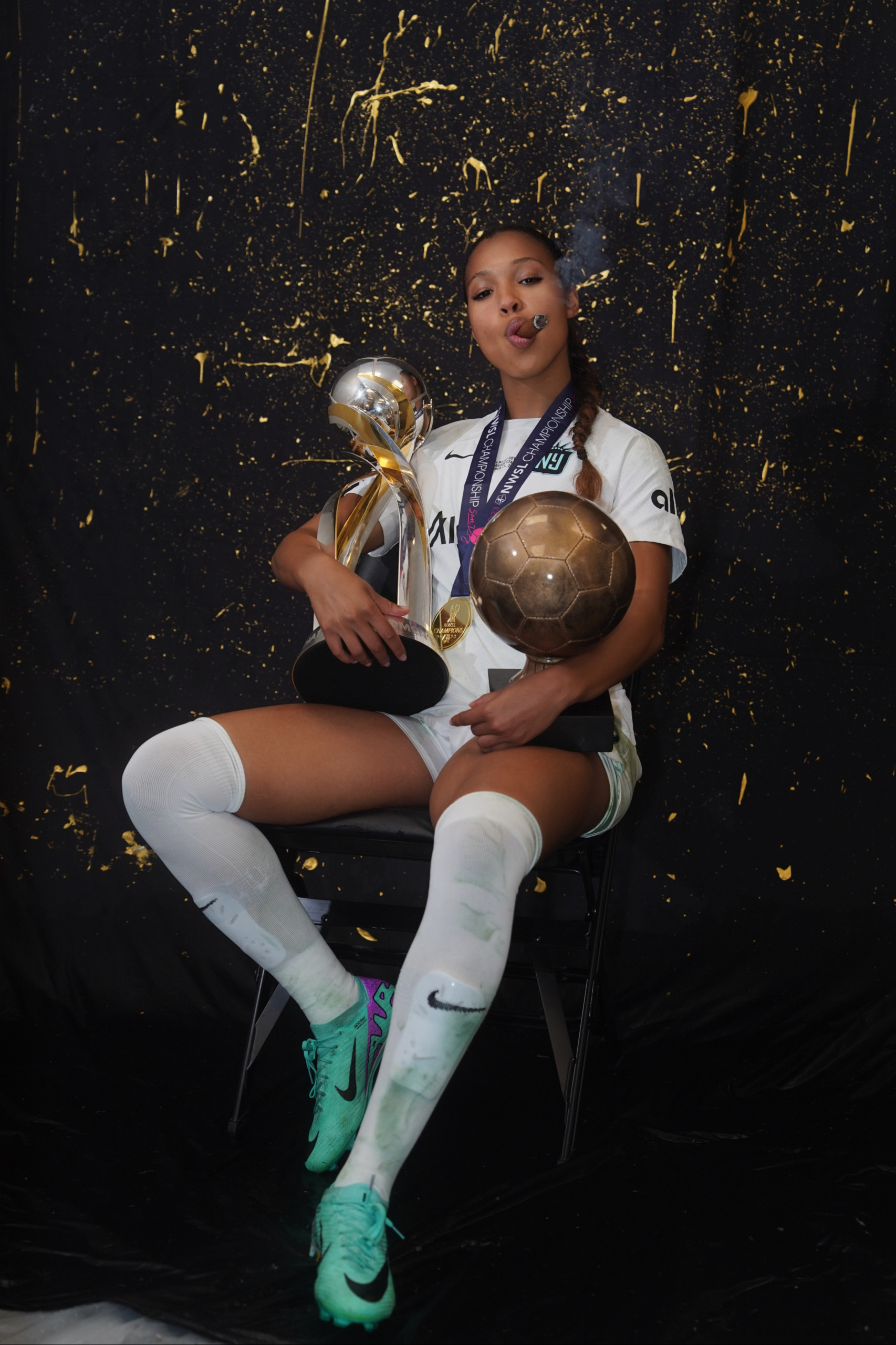 Photo Credit: Gotham FC
In recognition of Equal Pay Day, ESSENCE spoke with Purce about why compensation represents something larger for women athletes. She also discusses the growing business of women’s soccer, her work with the Black Women’s Players Collective and the conversations she is having through Confessions of an Elite Athlete.
“Equal pay to me honestly is more of a signal to equal value,” Purce said. “We inherently devalue a service when it’s done by women in sport, and that is the messaging and the essence that we’re fighting against.”
ESSENCE: So for my first question, I wanted to talk about equal pay. What does equal pay mean to you beyond the athlete’s paycheck?
Midge Purce: Equal pay to me honestly is more of a signal to equal value. And I think that is the dog whistle conversation that’s lost upon people when we’re talking about equal pay. I think that’s the dog whistle conversation that is lost upon people when we begin to speak about equal pay is we forget that what we’re actually talking about is the value of a service. And we inherently devalue a service when it’s done by women in sport, and that is the messaging and the essence that we’re fighting against.
How do you balance your advocacy with being able to still compete at the highest level?
MP: It’s funny, because I get this question a lot and I think it’s twofold. I think honestly, my performance at the highest level is a large piece of my advocacy. I think that is what gives me any legitimacy or credibility to be able to speak on the subject in a way that a spectator can’t. And it’s kind of my job to perform so that I can speak to something like this. And then at the same time, I think you follow what’s important to you, follow what’s important to your heart. And not that money is super important to me, but I think more women should feel okay and comfortable talking about the importance of funds and money. And so it is important to me and it’s important that not just myself, but other women are compensated well for, or not even well, appropriately for the work that they do.
So, expounding on that, as more money enters the league, how can the NWSL make sure that players benefit from this newfound success?
MP: I’m a big fan of getting rid of the salary cap. I think it’s really easy. You just pay players and we don’t put a cap on that. So to me, that’s one big way that we could.
Where do you attribute that nature of advocacy from? Were you taught at a young age?
MP: I come from a single parent household and I was raised by my dad, and I like to say my dad and my big brother. So it really was a boy’s house for a long time. And I think when you’re raised in that kind of environment, you get a bit appalled when the world starts treating you in a way that they’re not treating everyone in your household. And a lot of the assumptions and entitlements that my dad and my brother felt in the world, I was met with a lot of pushback when I would navigate the world in those same ways. And I was blessed enough to have a dad and a brother who also believed that I was entitled to the same things that they were. So I think it was principally something in my house where my dad always spoke about the importance of equal pay.
It was something that was important to him having a daughter and not having a daughter. And I think that when I’m passionate about something, I just keep going for it. So it’s just something that speaks to my heart and when something speaks to me, I also have to speak on it.
What has co-founding the Black Woman Players Collective taught you about the needs of Black athletes and Black players?
MP: The “needs” is such an interesting question because I don’t get the question about the “needs.” I always get the question about what’s your favorite part of it? What’s the most amazing thing? But I think the biggest piece that goes unnoticed is that a lot of players need a mouthpiece.
It’s the power of your voice that gets dimmed down when it’s solo, when you’re a Black player a lot of the time about some of the issues that you’re speaking about. And what the Black Women’s Players Collective did was it gave so much more credibility and power to the individual voices who were presenting something that was important to them and something that we felt like was our reality that we were facing and fighting for. And it really emboldened a lot of players to take part in an organization and in, I don’t even like to call it philanthropic because I just kind of feel like it’s your responsibility when you’re in a privileged position to help and support others so that they can get to the same position. But it really was an aspirational, inspirational venture that allowed a lot of people to come together in a community space that was super empowering.
…you brought up the word “voice” in your response just now. So I want to talk about Confessions of an Elite Athlete—your voice and your show. What do you think that has been able to do that you couldn’t express through the sport of soccer alone?
MP: I think as an athlete, we do a lot of interviews and we get a lot of journalists. And something that I’ve always said is that the conversation I’ll have with my teammates or another athlete will never be the same as one that I have with a journalist or outside media. There’s just this different language and it comes from a shared experience and a shared understanding of what you’re going through, same that would happen in any industry that allows you to talk about things in a way that you just can’t in any other setting. So I think it’s allowed us to pull back the layers to have conversations that we have behind closed doors on a bigger, larger public platform.
What part of an athlete’s life do you think that fans understand the least?
MP: In today’s age, honestly, I think it’s the mental piece. I think the NFL is probably one of the better examples, NFL and maybe European football, just how difficult it is for an athlete to also maintain the human side when you’re supposed to perform at an elite level all the time. I think sometimes you forget that it’s either just a kid or it’s just a person and those people make mistakes all the time. But I think that it’s the human side that you forget when you’re watching people on television, when you’re watching people in big moments.
You have so much more life to live, but I want to know: up until now, what is the accomplishment you’re most proud of?
MP: Wow. I’m not sure. I don’t want to give you a bad answer. I only have to walk it back later.
I mean, I’m pretty sure it’ll change eventually. (Laughs.) But just to this particular moment, do you have anything I guess that stands out to you the most that you’ve been able to accomplish?
MP: Well, I don’t know if this is my proudest, but something that sticks out is definitely working on the collective bargaining agreement for the US Women’s National Team and accomplishing equal pay in our country.
That’s a big one. That’s a huge one.
MP: Thank you. That was a big one. That was really important to me and collective bargaining takes a lot of energy and a lot of time more than people think. So that one was a long-term investment from me mentally and energy wise. So that one meant a lot to me.




 English (US) ·