
 2 days ago
3
2 days ago
3
ARTICLE AD BOX
“Business can be a complicated thing,” Desiree Talley said.
For her, understanding the business behind entertainment can be the difference between protecting an idea and watching someone else profit from it. As a legal executive at REVOLT, she has spent years working behind the scenes while helping creatives better understand the agreements governing their work.
Talley has brought her expertise to POPLAW, her five-time award-winning podcast now entering its third season. The series grew from something she repeatedly encountered among creatives who came to her with legal questions. Some entered meetings without proper protection, while others struggled to understand what rights they had when opportunities went wrong. Rather than provide individual legal advice, Talley created a public resource where those situations could become lessons.
Celebrity legal disputes became her way into the conversation, because it’s something that can be easily digestible. POPLAW uses cases involving familiar names to explain issues such as contracts and copyright in language people outside the profession can understand. “When I initially started POPLAW, I was only doing it for fun to educate my people,” Talley said.
“My mission is the advancement, education, and protection of Black people and culture,” she continued. “So I was doing it simply for them. As I continued to grow and travel to different countries to be asked to speak on panels and talk about POPLAW and podcasting—Saudi Arabia, Dubai, even in Europe—I said, ‘okay, there are people that are really interested in this.’”
Her work eventually led Talley to REVOLT, where she has contributed to programming including Caresha Please and Drink Champs. She also helped launch the REVOLT Podcast Network, bringing POPLAW into video after roughly 100 audio episodes.
Now recognized as one of this year’s LA Women to Watch, Talley spoke with ESSENCE about protecting creative work, choosing the right attorney and what creators should understand about ownership.
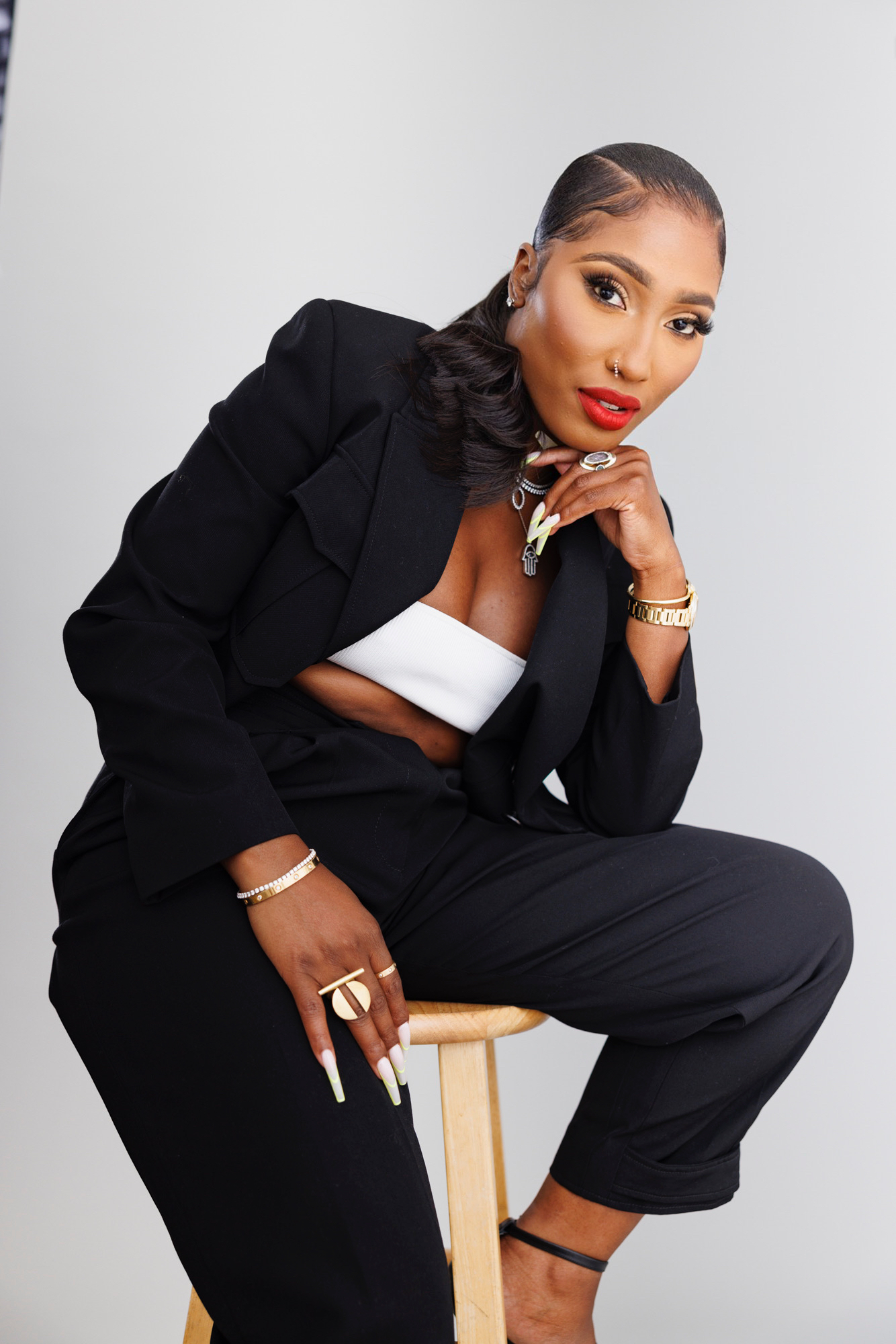 Photo Credit: Nolwen Cifuentes
ESSENCE: What inspired you to create the POPLAW podcast?
Desiree Talley: Whether they were artists, graphic designers, writers, or they just needed legal representation—they did not know how to manage some of the meetings that they were getting for their artistry or creativity. Sometimes they would get meetings with different large companies for their ideas. They didn’t sign NDAs and then they would see the work that they presented show up in other spaces and they weren’t hired for the job. So in order to try to help people on a mass level, and instead of giving free legal advice, which I can be liable for, I decided to start the podcast to talk about different scenarios where they can get that same information but for free and not have to pay an attorney.
Why do you think so many creatives overlook the legal side of the entertainment industry?
DT: I think people are fearful of it. They believe that legal fees cost a lot of money. It could be, but it costs more to clean up a mess than to just hire an attorney outright to get guidance on what you’re working on. And then sometimes they don’t know where to look for people or who to trust. With social media, it’s a little bit easier to find attorneys now that attorneys are marketing themselves in services. But when I was getting started, it was very difficult.
How have you been able to make information palatable to people that might not be knowledgeable about the legal side of things?
DT: Using initially celebrity lawsuits has been the niche for POPLAW. If people see that their favorite artist is going through a similar situation, mostly they’re nosy, they want to hear the gossip aspect of that. But for me, I decided, let me take this scenario, let’s say copyright mark or something like that where a person is stealing someone’s song, let’s say, or sampling a song. If I can talk about your favorite artist going through this situation that you’re paying attention to already, then you’ll hear the legal aspect of it. And I’m also giving you the tools in layman’s terms, I’m not talking in legalese for you to understand if this happens to me, these are the steps that I can take or happen to them. These are the steps that I can take to prevent it from happening to me as well.
…and how did you initially connect with Revolt?
DT: I don’t remember if I applied or if they sought me. At the time I was at Bustle Digital Group working in digital magazines and that role was very fulfilling, but I always wanted to work for a Black-owned company. So when the Revolt opportunity came by, I met with a bunch of the team members. I loved the work that they were doing, and it was just exciting to see again, some of our favorite artists being able to be a part of their projects and some of the television shows. It was kind of a no-brainer for me. I’m a radical on the inside, so I thought: Let me go over here to Revolt and be able to take all the knowledge that I have from large corporate white institutions and be able to apply that not only to the business and legal aspect for the company, but for the talent that we’re working with.
So with that, I was able to do that. Maybe four, six months in, Revolt wanted to launch a podcast network. They were familiar with POPLAW. At that time, POPLAW was only an audio podcast and probably had a hundred episodes. So I was a part of the founding group to launch the Revolt Podcast Network and then added a video component, which the company felt was really important because a lot of attorneys, from what I’m told, don’t look like me or have the experience as me. So they thought it was important for people to see me as well.
Is there anything that surprised you the most about your life, your career, and your experiences since you launched this podcast?
DT: Definitely the amount of people across the world that listen to it. Not only from a creative aspect, but other attorneys who are inspired not only to go to law school and become an attorney, but they’re also finding their path into entertainment.” Also, knowing that you can be visible with an attorney was something that made me say, “okay, this is actually a real business that I need to turn this into and not just make it for fun,” although I still have fun doing it.
What’s the most common mistake you see artists and creatives making when they’re signing deals or looking for deals?
DT: Initially, the biggest mistake is people not having an attorney or having the right attorney. Sometimes people may not have any connections with an attorney, so they might hire an attorney who was recommended to them by a label. For me, that’s a red flag. That’s a conflict of interest. You don’t know what side that attorney is really working on. Recently, I’m seeing people putting any contracts or agreements and AI platforms and tools and solely relying on that as their lawyer and legal advice, which can be dangerous. The AI tool doesn’t know the relationship. They don’t know where you want to go. They don’t necessarily have judgment and the tools are only as good as the information that it’s fed. So that’s something that is becoming really dangerous. Now, I’m not saying don’t do it. It can kind of break down exactly what things mean, but it doesn’t have the full scope. So I really caution people on relying on AI tools right now for legal advice or as their lawyer.
What would one do in order to find a trustworthy attorney?
DT: When choosing, look at their LinkedIn profile, see where they have worked. Attorneys sometimes now are posting different deals that they worked on, but you want to know what exactly that they have done. I definitely recommend researching and really trying to find someone that knows has worked with them. Also, making sure that person that you’re hiring as an attorney has a specialty in the area in which you need assistance. The example that most entertainment lawyers like to use is you can’t hire a personal injury attorney to read an entertainment contract and negotiate that for you.
For example, I’m an entertainment attorney, strictly transactional. I do not do litigation. Even if it’s an entertainment related matter, I’m not the attorney to go to court for you, but I can point you in the direction with people that I’ve worked with. So word of mouth, I would say, is also important in addition to doing your own due diligence and looking up their background.
You’ve been awarded with several honors—what do those awards mean to you at this point in your life and career?
DT: The awards and honors, it gives me that, I wouldn’t say validation, but lets me know that I’m doing the right work, that I’m sticking to the mission and it’s not for show and people are paying attention. I really care about the work I do. I’m very passionate about it. Anyone who sat on the other side of the table for me, they can definitely speak to that, but it shows that it means something. I’m the first person in my family to go to college, first person to become a lawyer, and I figured it all out through Google. I didn’t have someone to give me the right guidance. And to this day, I still don’t have a mentor, so I am seeking one, but it’s showing me, okay, you have great discernment, you are doing the work, continue to put up these shots and someone will recognize and give you those rewards to keep on going because it can be lonely when you’re figuring it out on your own.
With POPLAW, how do you decide which themes and topics to explore each season, each episode?
DT: I don’t necessarily focus on what’s trending, but something that is evergreen, or even an old case with your favorite artist that happened three or four years ago, but it still can be relevant today because history repeats itself. One, as I’m entering into season three, something that I’ve been holding and I’m thinking about speaking on is Kanye West’s Adidas contract situation. And while that has happened a long time ago, what I do is take out all the salacious parts of it, and ask “what was something that would be important for our audience, or what is something that they should be mindful of when they’re doing partnerships with different brands?” For example, with that case, I might focus on morals clauses and a morals clause is when a company can terminate based on how your personal reputation is, and if it paints them in a bad light, it puts them in a bad space.
So while that case is old, that’s still something that can happen today, whether you are partnering with a large corporation or someone small, it’s that reputation and personal aspect. So just finding things that are not highly talked about, but people need to know that are important when you’re dealing with people, brands, companies, and going through life in general.
Why do you think ownership is such an important conversation in today’s creator economy?
DT: Ownership is really important because there’s so much money to be made or that companies have, and you only get a fraction of that. So being able to, let’s say, build that generational wealth, what we all want, ownership is important. But I do say that people shouldn’t necessarily get stuck on full ownership. You can own 100% of something and it be valued at zero, so giving up ownership in some situations is okay. There is also a thing that’s subject to revision. You may be able to give up ownership for five, 10, 25 years like Ryan Coogler did with Sinners, but after a certain time, if you negotiate properly, you can revert those rights back. So let people have ownership, get your paperwork right. When people have ownership of something else too, then they have more incentive to go out and work, particularly if you couldn’t pay them in advance, let’s say, and they want to make sure what they get on the back end is very lucrative.
You’re an HBCU graduate. How do you think your experience at a HBCU informed how you move through business today?
DT: Being at Hampton University was an amazing experience. I’m from California, so I grew up in a melting pot. It was a little bit of a culture shock at first to be around all Black people, but I loved having Black classmates and Black teachers. That’s something that I didn’t really have growing up the whole time. So seeing Black people from different walks of life, super wealthy families, trust fund babies, middle class, low class, it was all just a great experience. And that prepared me for the world. Growing up in California, I grew up in a little bubble. Sometimes I still feel like I’m in a little bubble, but that helped shape who I am. I want my kids to eventually, when I have kids, go to a HBCU, but I think it gives you that foundation of real life and what to expect when you go out into the workforce or even if you are your own entrepreneur, just having that pride and be able to walk with confidence into any room that you are in is nothing that you will ever experience or I feel like be able to obtain outside of a HBCU.
What’s one piece of legal advice that every creator should know before launching a business or brand?
DT: Ask questions from people who have done it, ask people and use your network. Sometimes we always think that we have to look up for people who are doing it ahead of us who have already done it. But I would say the biggest lesson that I have learned and I think is really important in my practice is to also seek guidance and mentorship from your peers because your friends do different work than you in some cases and have different life experiences and that can help you when you are building your business. One thing that my friends and I are implementing is having, we’re going to try to do it monthly, but it might be quarterly, is these work sessions to really understand what the other person does. So we vaguely know, but do we know in detail what the other person does? Absolutely not. So we’re incorporating that so we can understand, all right, instead of me going to find other resources, how can we work together? How can we build together outside of brunches and lunches?




 English (US) ·